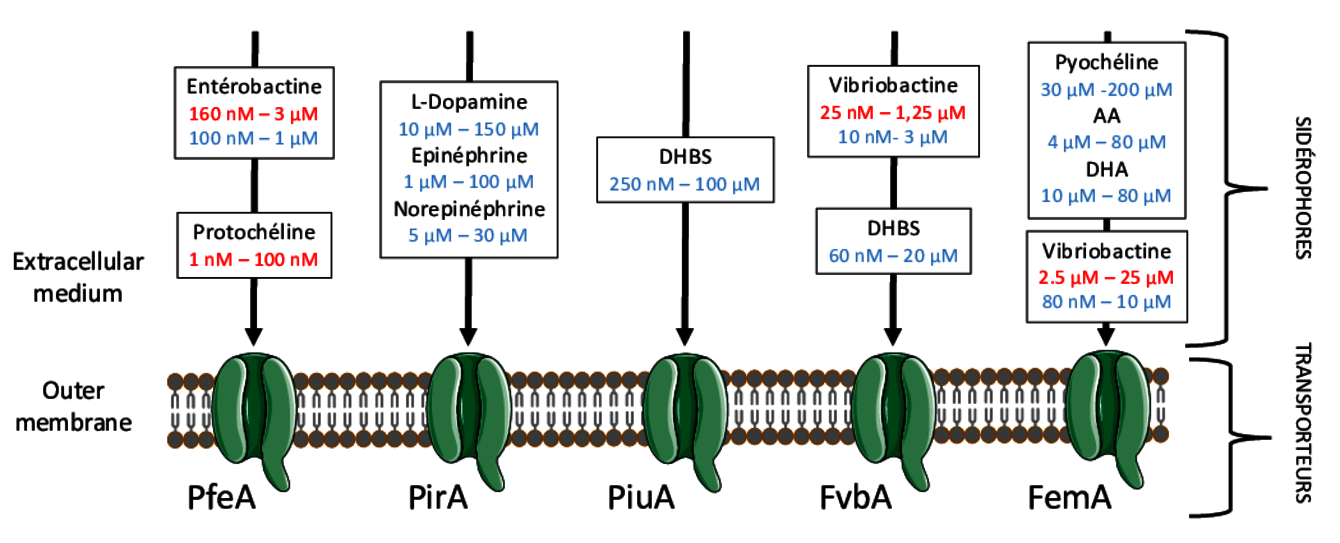

Iron is essential for bacterial survival, but it is particularly difficult to access within the host. To acquire it, the opportunistic pathogen Pseudomonas aeruginosa possesses 21 transport systems located in its outer membrane, enabling it in particular to exploit siderophores—small molecules capable of binding iron. However, the bacterium expresses only the systems that are most advantageous depending on the resources available in its environment, and can even use siderophores produced by other microorganisms, through a strategy known as “siderophore piracy.”
In this study, published in the journal PNAS, the team sought to understand how P. aeruginosa detects different catechol-type molecules to regulate the expression of transporters involved in iron acquisition. Using fluorescent reporters and mathematical modelling, the researchers measured the responses of five transporters to different catechol-type siderophores and to host-produced catecholamines, such as adrenaline, noradrenaline and L-DOPA.
The results reveal distinct regulatory strategies depending on the transporter and show how the bacterium integrates information from both its environment and iron availability. P. aeruginosa can therefore finely tune its iron acquisition arsenal to the conditions it encounters, whether in a competitive microbial environment or in a host-associated context.
These findings provide new insights into the adaptation of Gram-negative bacteria and siderophore piracy. They also have therapeutic implications : some iron transporters serve as entry points for antibiotics such as cefiderocol. Understanding the conditions that control their expression could therefore help improve our understanding of the efficacy of these therapeutic strategies.
Article:
Distinct transcriptional logics of catechol siderophore transporters in Pseudomonas aeruginosa for efficient iron acquisition. Proc Natl Acad Sci U S A 123(33):e2602150123. doi: 10.1073/pnas.2602150123.