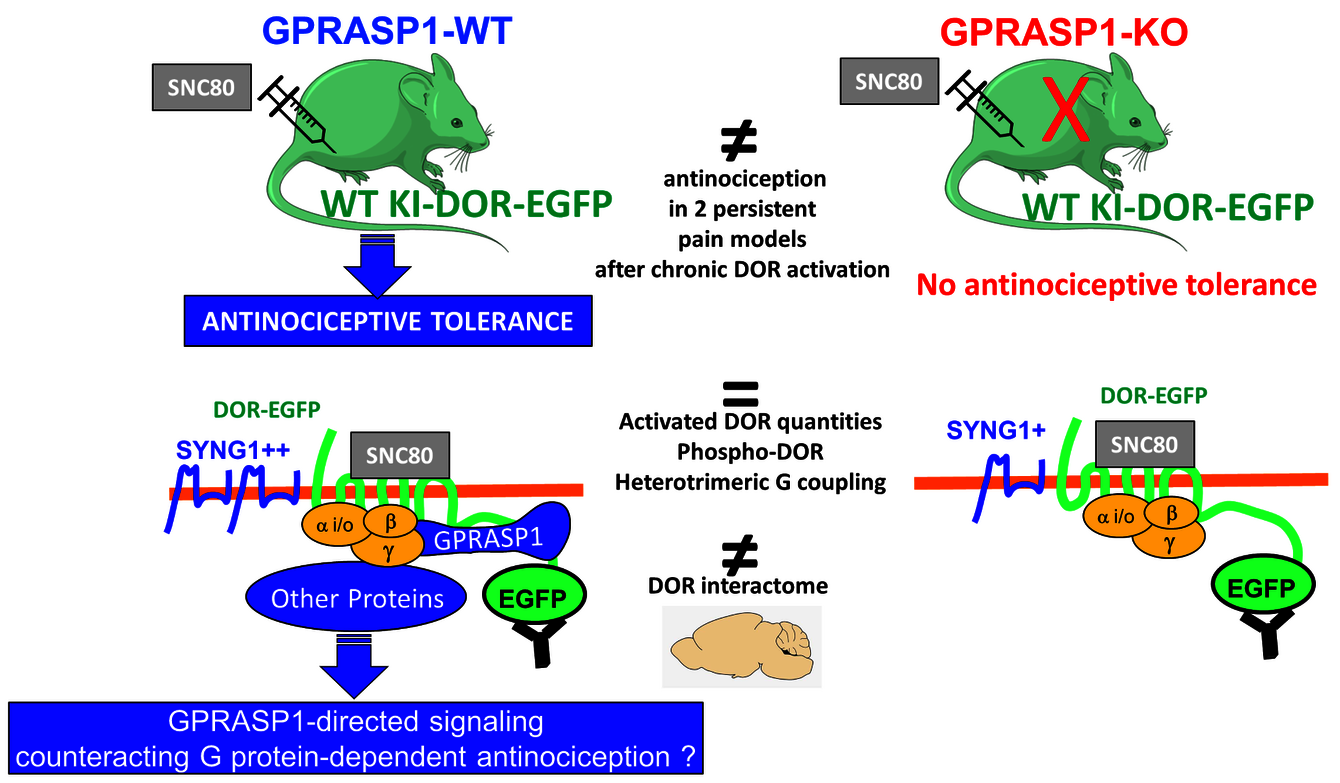

Drug tolerance, the progressive decrease in treatment effectiveness requiring increasingly higher doses, represents a major challenge.
GPRASP1 is a protein that interacts with numerous G protein–coupled receptors (GPCRs), which are the targets of 35% of marketed drugs. Two studies co-led by Frédéric Simonin and Sandra Lecat, from the “GPCR, Pain, and Inflammation” team, reveal that inactivation of GPRASP1 blocks the development of tolerance to either a bronchodilator (asthma) or a delta-opioid receptor ligand (pain).
These findings, published in Biomedicine & Pharmacotherapy in 2025 and early 2026, show that repeated stimulation of the Beta-2 adrenergic receptor (in respiratory function) or the delta-opioid receptor (in chronic pain) leads to tolerance development, a phenomenon completely absent in GPRASP1 knockout (KO) animals, even though receptor degradation is identical to that observed in wild-type animals. These studies therefore challenge the prevailing hypothesis that tolerance is linked to degradation of the target receptors.
In collaboration with INCI (Strasbourg) and IGF (Montpellier), the team also conducted the first comparison between the interactome of a GPCR extracted from mouse brains under basal conditions or after repeated activation, identifying new proteins potentially involved with GPRASP1 in delta-opioid receptor signaling and the development of analgesic tolerance.
Altogether, current knowledge about GPRASP1 suggests that this protein could become a novel therapeutic target to prevent the loss of efficacy of ligand drugs that activate G protein-coupled receptors.
Articles:
GPRASP1 deletion suppresses antinociceptive tolerance during chronic activation of delta opioid receptor in persistent pain. Biomed Pharmacother 194:118913. doi: 10.1016/j.biopha.2025.118913.
Abu-Helo A, Daubeuf F, Tranchant T, Lehalle C, Elhabazi K, Zeder-Lutz G, Kugler V, Lugnier C, Frossard N*, Lecat S*, Simonin F* (2025). GPRASP1 deletion in mice abrogates adverse side effects associated with chronic stimulation of Beta2-adrenoceptor. Biomed Pharmacother 187:118073. doi: 10.1016/j.biopha.2025.118073.